Choose which cookies you allow us to use. You can update this at any time via the cookie settings link in the footer.
Strictly Necessary
Required for the site to function correctly. Cannot be disabled.
Analytics
Helps us understand how visitors use the site (Google Analytics 4). No personal data is sold.
Marketing & Advertising
Used for Google Ads and to serve relevant advertising. Requires your consent under UK PECR.
Training
The drop-off in speed after 40 is far slower, and far more within your control, than most runners assume. A large part of the speed people "lose" isn't lost to age at all. It's lost to training that gradually became all steady miles and no fast running.

What Actually Changes
As an older athlete I've noticed that my raw top-end speed and my ability to recruit and maintain fast-twitch muscle fibres has declined, the bit that makes you feel fast and powerful. I've also noticed that my maximum aerobic capacity, the ceiling on how much oxygen I can use, has declined slowly over the years.
To reduce the decline, it's important we keep an element of faster pace running within our schedules. You've heard the expression: if you don't use it, you'll lose it. Fast-twitch fibres respond very much to this principle. When runners stop doing intervals or faster pace work, the body starts to become what I call "wooden legged". Much of the age-related speed loss runners experience is really disuse dressed up as ageing.
"The masters runners who stay fast all have one thing in common. They keep in touch with faster pace work."
The Good News
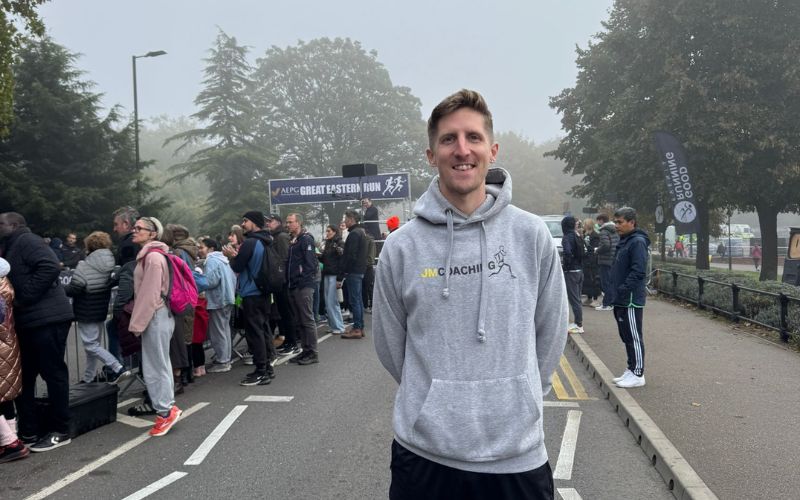
Over the years I've learnt to stay fast by keeping in touch with faster pace work. Whether that's intervals on the track, strides after an easy run, or fartlek. I've always tried to stay fast and stayed as consistent as possible in the gym. By doing that I set a 10km personal best of 28:15 aged 38, following the same principles I share with the masters athletes I coach.
The masters runners who stay fast all have one thing in common. They keep in touch with faster pace work.
The Work That Works
Short, relaxed accelerations of around 15 to 20 seconds, run a couple of times a week after an easy run. They're low-stress, they teach your legs to turn over quickly, and they're one of the most effective and underused tools for maintaining speed. If you do nothing else from this list, do strides.
Repetitions at a fast but controlled pace, with full recovery between them, keep your fast-twitch fibres engaged without the heavy fatigue of longer, harder sessions. The full recovery is what makes these sustainable for masters runners. When training for a marathon I often run 400m repeats as part of my build to stay fast. It's much quicker than marathon pace, and the shorter reps are less taxing on the body than longer VO2 max length intervals.
Short hill sprints build power and recruit fast fibres, with the added benefit of being lower impact than flat sprinting, which is kinder to ageing tendons and joints.
Sustained efforts at a "comfortably hard" pace maintain your ability to hold speed over distance. This is the engine behind strong 10k, half marathon and marathon times. I've even introduced double threshold sessions as an older athlete, which when done correctly and at the right times can make a big difference.
The theme running through all of these: touch different speeds regularly. Variety keeps the whole system sharp, which is true for runners of all ages.
The Golden Rule
If there's a single principle for staying fast after 40, it's this: please keep some fast running in your week, all year round. The instinct as we age is to drift toward comfortable, steady mileage, because it feels productive and it's easier to recover from. But a diet of only steady running teaches your body to be good at only one thing: running steadily. Regular exposure to faster paces, even in small doses, tells your body that quick still matters.
You don't need much. A set of strides twice a week and one faster session keeps far more speed alive than most runners realise.
The Other Side of Speed
Faster running places more demand on the body, so the flip side of staying fast is recovering well enough to keep doing it. This is where masters runners have to be smarter than they were at 25. The aim is quality over quantity, fewer hard efforts, fully recovered, rather than lots of moderately hard running that leaves you permanently flat. Our post on recovery for masters runners goes deeper on this.
Speed is partly a strength and power quality, not just an aerobic one. Strength training helps you maintain the fast-twitch power and the efficient, springy stride that fade fastest with age. For masters runners, it's one of the highest-value things you can add.
Where a Coach Comes In
Staying fast after 40 is a balancing act: enough fast work to keep feeling fast, enough recovery to absorb it, and enough strength to support it. Judging that balance for your body, your schedule and your goals is exactly where a coach can help you. We build masters plans that keep faster pace work in, importantly the right amount of it and at the right times, so you keep your speed for years rather than watching it quietly slip away.
Our masters running coaching programme is built around exactly this. Structured, progressive training with speed work included at the right dose for you.
Common Questions
Some decline in raw top-end speed is natural, but it's slower and more controllable than most runners think. A large part of the speed people lose after 40 comes from dropping fast running, not from age itself. Keep some speed work in your week and you'll hold on to far more of it.
Regular exposure to faster paces is the key: strides, short intervals with full recovery, hill sprints and threshold work, combined with good recovery and strength training. The principle is simple: use it or lose it.
Yes. Short, relaxed accelerations of 15 to 20 seconds are one of the most effective and lowest-risk ways to maintain leg speed. Done a couple of times a week, they keep your fast-twitch fibres engaged with very little fatigue.
Many runners do. Running economy, strength, and your ability to hold pace all stay trainable well into your forties and beyond. With consistent, well-structured training, improvement is realistic for a long time.
Summary
Speed doesn't have to disappear after 40. What disappears for most runners is the fast running that keeps it alive. Bring back the strides, keep one short faster session in your week, add some strength work, and pair it all with proper recovery. Do that consistently and you'll be surprised how much speed is still there for you to use.
Want to keep your speed for years to come? Our coaches build masters plans that keep the fast work in, at the right dose. Explore our coaching or book a free call.

Founder of JM Coaching, 2:08:45 marathon runner and Great Britain international. 10km PB of 28:15 aged 38, equalling the V35 record set by Sir Mo Farah. Read his full profile.
Masters coaching that keeps the fast work in, at the right dose, so you keep your speed rather than watch it slip.
Masters Coaching